Sea level-induced oyster reef accretion causes minimal net carbon burial change
Abstract
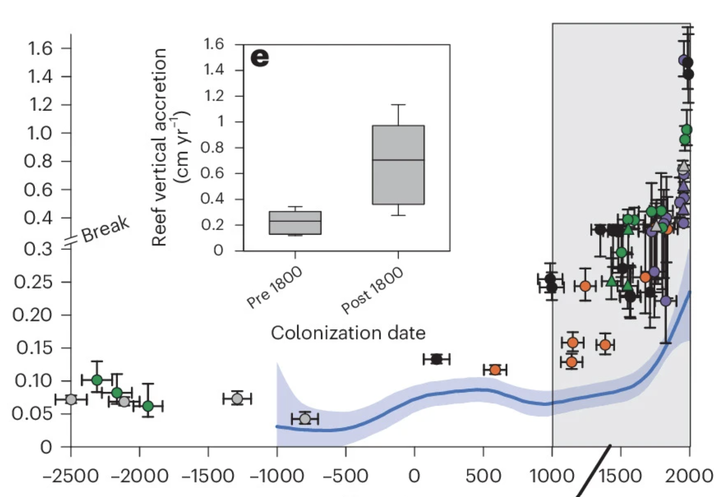
Nature-based infrastructure, such as oyster reefs and salt marshes, is increasingly being promoted as effective breakwaters to protect communities from storm waves and as carbon burial hotspots to mitigate greenhouse gas emissions. The function of oyster reefs as breakwaters and carbon sinks is commonly supported by information extracted from extant reefs <10 years old; however, both services depend on sediment accumulation, which operates over decadal to millennial timescales. Here we show that the rate of sea-level rise (SLR) drives eastern oyster reef vertical accretion and carbon burial. As relative SLR increased after 1800 CE to the modern rate of ~2.4 mm yr−1, intertidal reefs accreted vertically and accumulated sediment three times faster than during the previous 18 centuries when SLR was ~0.9 mm yr−1. Reef accretion rates were driven by the flux of shell and organic-rich sediments to the subsurface; however, none of the 25 reefs sampled functioned as net carbon sinks because the organic carbon buried was offset by the CO2 emitted during shell formation. Our results suggest that, as SLR accelerates, the vertical growth of healthy reefs has the potential to rapidly respond, with reefs becoming larger sources of CO2 but maintaining their effectiveness at damping waves. The ongoing deterioration of estuarine conditions needed to sustain healthy oyster reefs cautions against projecting these ecosystem service trade-offs into the future.